
 Loading...
Before watching Sinners, most of us already have a general understanding of what horror movies tend to do. We expect a certain atmosphere—dark spaces, uncomfortable silences, a slow buildup of dread, and characters who are gradually pushed out of their comfort zones. Even if we don’t know the plot ahead of time, we bring expectations with us: something is going to go wrong, and the film will slowly teach us how to read its specific kind of danger. That sense of anticipation is part of what makes horror work, and it shapes how we approach any new horror film before it even starts.
Comparing Sinners with Annabelle highlights how differently horror films can operate even when they share these broad expectations. Sinners focuses on moral and emotional horror—fear that comes from guilt, secrecy, and the consequences of someone’s own decisions. Nothing supernatural follows the characters; instead, the horror grows from the pressure of what they’ve done and the reality that they will eventually have to face it. On the other hand, Annabelle uses classic supernatural horror. The threat is literal, external, and violent. A demonic presence attached to the doll disrupts a family’s attempt to build a normal, peaceful life. The characters didn’t create the evil haunting them—it arrives unexpectedly and forces them into a fight for safety and understanding. Despite these differences, both films show how quickly an ordinary world can fall apart when a hidden truth or unexpected force begins to reveal itself.
Each film also demonstrates Modus Legendi, or the way a film teaches the audience how to watch it. In Sinners, the film uses still shots, heavy shadows, and long moments where nothing is said. These choices tell us that the story’s meaning is tucked into small gestures and charged silences. We learn to pay attention to what characters avoid saying, the shift of someone’s eyes, or the tension in a conversation. The horror depends on slow recognition—ours and the characters’—of what they’ve buried.
Annabelle sets up its viewing “rules” very differently. The film immediately introduces signs of supernatural activity: strange noises, flickering lights, ritual symbols, and of course the doll itself, which is framed in a way that keeps pulling our attention back to it. The movie trains us to expect jump scares and sudden shifts. We’re supposed to look at the corners of the frame, to pay attention to the things that move when they shouldn’t, or the moments when the room feels too still. The film moves faster and more unpredictably, and our expectations shift from subtle emotional cues to the possibility of something physically dangerous happening at any moment.
The visual techniques in each movie support their different approaches to horror. In Sinners, the muted colors and slow pacing build an atmosphere thick with emotional weight. Even small details—like a door left slightly open or a character freezing for just a second too long—act as clues that something inside them is about to boil over. The film isn’t trying to shock us; it’s trying to make us feel the heaviness the characters carry.
In Annabelle, the visuals do the opposite. Quick camera movements and sharp sound cues keep the audience on edge. Bright, ordinary spaces like a nursery are suddenly corrupted by symbols, shadows, or the doll’s unsettling presence. Instead of slow dread, the film builds tension by constantly threatening to break the normal world apart.
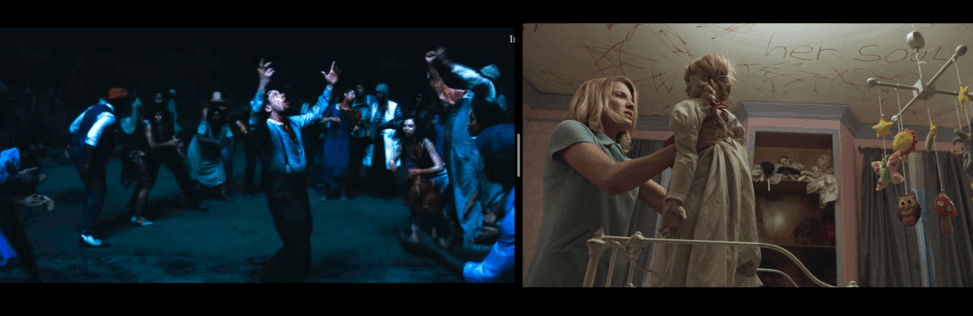
Both films contain turning points that reveal their central ideas. In Sinners, the pivotal moment occurs when the main character is completely overwhelmed by a chaotic crowd. Surrounded and panicked, he can no longer hide from what he’s done, and we understand that the real horror is the collapse of his own ability to escape the truth. In Annabelle, the nursery scene—where Mia finds the room vandalized and marked with “her soul”—is the moment when the supernatural threat becomes undeniable. It’s no longer just strange noises or objects moving. The demon has made its intentions clear, and the stakes for Mia and her child rise dramatically.
Even though Sinners and Annabelle belong to the same genre, they show how many different forms horror can take. One uses inner collapse; the other uses external invasion. One moves slowly, the other aggressively. Yet both remind us that horror depends on how a story shapes our expectations and how quickly the familiar can twist into something terrifying.

Got Feedback?
What do you think of this item? Love you some SPLOT? Let us know!