The Reality of Subscriptions in 2024
In the last ten years there has been a clear transition to the subscription business model across the board. Starting with streaming, and now going as far as health, software, and even niche previously free services. We have taken a step away from ownership, and another towards monitoring in the form of data surveillance. The subscription business model is out of hand and redundant. It is required where it isn’t necessary, using the front of convenience corporations have cornered a market where the product begins to consume the consumer using data and a billing system which changes the function of any given market. It is at times predatory and the data implications of companies, using metadata to follow trends and understand their consumers is unethical.
My Experience with Subscriptions
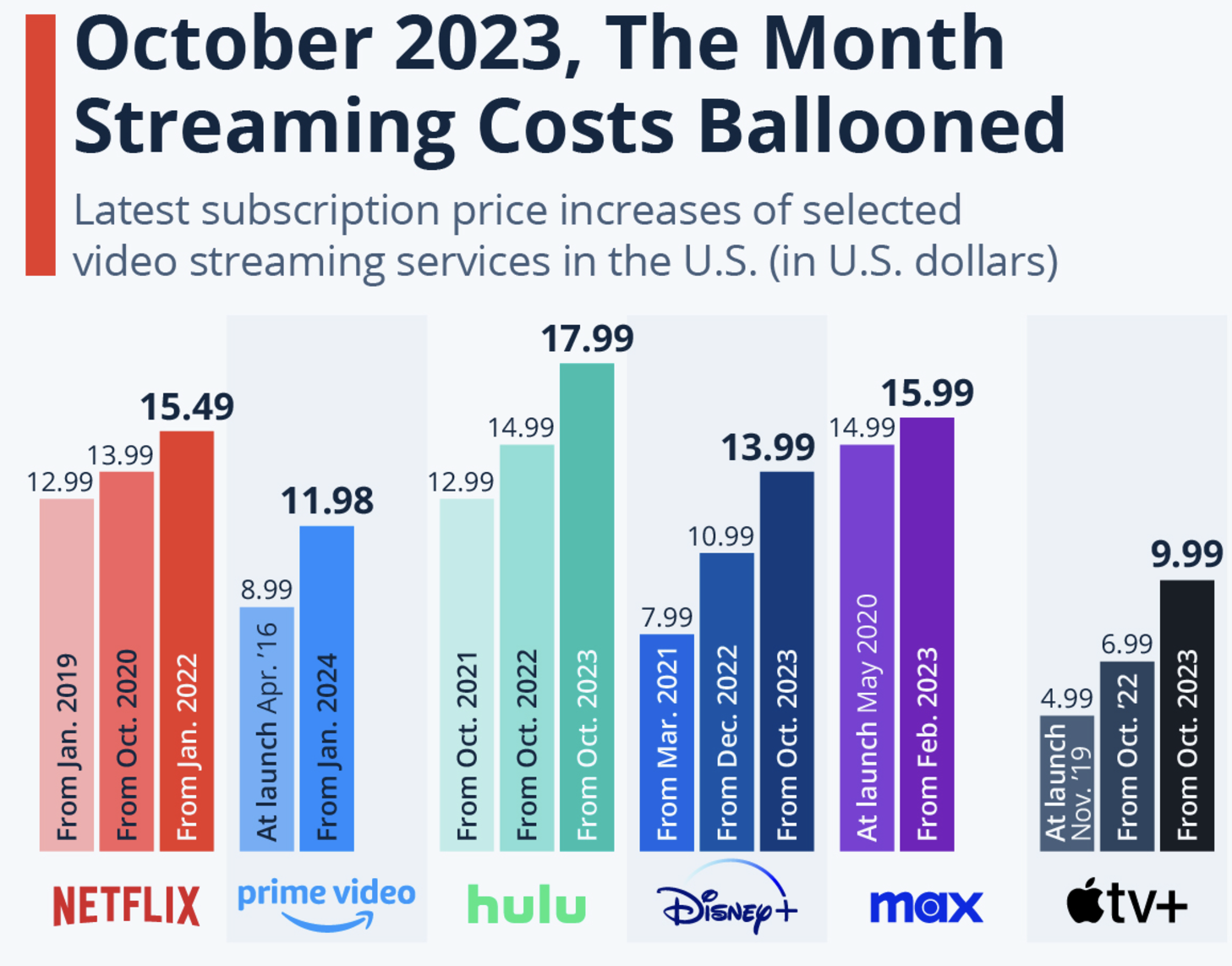
The first subscription I remember buying was netflix in 2014, it was convenient, cost effective, a seemingly perfect alternative to cable. There were no ads, a direct vast catalog of entertainment. I really enjoyed it, and continued my subscription all the way up until this last year. When I joined it was 7.99 a month, no ads, unlimited accounts. Before I canceled my subscription it was 14.99, advertisements, and limited to IP as well as only two accounts actively watching. The catalog had gotten marginally better, their own content which was created based on their data was bland and seemed to only fit the trends they seem to follow. I was kind of grossed out by the thought of a streaming service at that point, and since then I haven’t renewed or started any other subscriptions. It had transformed from a simple convenient program to an extraneous headache
What Makes Subscriptions Valuable?
Consumers decide whether a subscription service is right for them based on a number of factors, (Wang, Zhang, Ye & Nguyen 2005) “These factors are: convenience, essentiality, added value, perceived service quality, usage frequency, perceived fairness, and security concerns.”. The most interesting of these is perceived fairness often, similar to the oura ring presented, there is an element of unfairness to the subscription. It seems that the barrier to entry might warrant an offset of the subscription but it is mandatory. Usage frequency is how much the consumer will use the content, or service, if it is single use then it ought to not be a subscription yet some still are. Service quality is in some ways a moderation of all the given factors, it determines how satisfied the user is with the content or service. A great example of an ill-advised subscription model is the Tesla MyQ home integration which requires you spend 40$ a month to open your garage door. Had they followed these principles of a subscription service in the eyes of the consumer they could have avoided this blunder of an idea.
Rising Prices of Subscriptions and Loss of Apparent Value
In 2024, every dollar counts with inflation where it is. What was once valuable is no longer, its apparent value has diminished substantially given the loss of value of US currency. Not to mention the higher barrier to entry in not only homes, but vehicles, and parenting. Money is losing its value and our conveniences are becoming luxuries of yesterdays as prices increase. (West Monroe 2021) “The average monthly spend on subscription services is $273, up from $237 in 2018. This 15% increase equates to an additional $430 per year.” (p.1) prices are always increasing and as money gets tighter it seems that the corporations want to maintain their tremendous profits. We have witnessed a transition of ownership out of the hands of consumers directly into the hands of corporations. Subscriptions are a culprit in a world becoming increasingly less private, and increasingly harder to own anything in. Many businesses that warranted ownership of content or services such as the Microsoft Suite, DVD entertainment, and CD audio have moved away from ownership and towards licensing which must be renewed.
Data Surveillance, and Corporate Data Hoarding
The convenience of subscriptions is at the expense of the security and ownership. Not to mention the valuable data which is collected by corporate entities and then analyzed to find trends and is often sold to other companies or used against the will of the consumer. This data creates a weird inorganic ecosystem of content which triggers consumers more than ever, the sad part of this is the loss of creativity and organic generation of new content. It becomes a gross amalgamation of buzzwords and online trends shown by metadata, and consumers are aware of this (Shaji-George 2024) “And such covert motivations breeds deep distrust. Surveys reveal 87% of consumers worry about data privacy violations from companies tracking their behaviors online, while 74% believe they lack adequate control over personal information uses by subscription services they patronize”(p.124) It is almost like watching a lion stalk its prey. They are looking to take advantage of their consumer-base. They can keep the customer coming back by understanding what keeps them there. Often these types of algorithms or understandings of data can lead to social isolation, and negative feedback loops on the part of the consumers.
The 2024 Writer’s Strike as a Representation of Entertainment Streaming’s Intent
To pivot further on the bottom dollar of subscription services, think about the writer’s strike in 2023. Writers could not be guaranteed their job security at the foot of Artificial Intelligence. The entertainment industry’s hesitance to meet the needs of their writers makes it clear that the use of artificial intelligence was clearly in the cards for these corporate entities. They’re not in the business of entertainment, they’re in the business of profit, and they would literally sell the art at the expense of the writers using artificial intelligence. That is a pretty bleak reality. It took 148 days for the strike to come to a conclusion, in all reality the streaming companies only had to guarantee the bare minimum considering the striking workers already don’t receive nearly enough royalties (AP News 2024 ) “The strike was also about streaming-era economics, writers room minimums and residuals — not exactly compelling picket-sign fodder.” (para. 1). One would think that the crazy profits made from increasing prices in an inflation crisis could in some way incentivize these companies to see their need for deserved raises and job security. At the end of the day they are not people above writers, they are not a means to an end.
The Sad Future of Subscriptions
I worry that subscriptions may find their way outside of the predominantly entertainment industry. Software companies are making the transition to subscription licensing, companies like CISCO, Microsoft, Adobe, Salesforce, etc. Could there be a transition ever farther away from ownership. The fear is that one day we will get to a point where ownership is a thing of the past, your car is licensed to you, your home is already at this point because most mortgages are rentals because inflation costs in homes are so ridiculously high. While this may seem like a dim and pessimistic view of what could be, I worry that we may no longer own anything in the near future.
Conclusion
This decade has seen a turbulent increase in subscriptions and digitized culture. It is completely uncharted territory, the issue of data surveillance will have to be answered at some point. But at this point, it is safe to say that ownership has been beaten by subscriptions and the licensing way of business. The ethics of subscriptions may be corrected over time, or maybe by regulation. Will we see subscriptions continue to grow and use unethical practices? Will they be stopped? Will a more ethical and sustainable business model come into the mix? Only time will tell.
References
Discover Oura’s health, fitness, and sleep rings | Oura. (n.d.). Oura Ring. Retrieved November 14, 2024, from https://ouraring.com
Karim, A. (2018, July 20). Netflix and the rise of global scale media(Or how media learned to love its customers). Intrinsic Investing. https://intrinsicinvesting.com/2018/07/20/netflix-and-rise-of-global-scale-media/
Parris, D. (n.d.). What is cable tv in 2024? A statistical analysis. Retrieved November 14, 2024, from https://www.statsignificant.com/p/what-is-cable-tv-in-2024-a-statistical
George, D. A. S. (2024). Unsubscribe from anxiety: The psychological costs of subscription service overload. Partners Universal International Innovation Journal (PUIIJ), 02(03), 115–131. https://doi.org/10.5281/zenodo.12170957
Subscription Business Revenue Grows 437% Over Nearly a Decade as Consumer Buying Preferences Shift from Ownership to Usership. (2021, March 3). Www.businesswire.com. https://www.businesswire.com/news/home/20210303005291/en/Subscription-Business-Revenue-Grows-437-Over-Nearly-a-Decade-as-Consumer-Buying-Preferences-Shift-from-Ownership-to-Usership
Analyzing digital equity in u. S. Cities. (n.d.). United Way NCA. Retrieved November 14, 2024, from https://unitedwaynca.org/blog/analyzing-digital-equity-in-america/
Schimmer, R., Geschuhn, K. K., & Vogler, A. (2015). Disrupting the subscription journals’ business model for the necessary large-scale transformation to open access. doi:10.17617/1.3.
Infographic: October 2023, the month streaming costs ballooned. (2024, February 8). Statista Daily Data. https://www.statista.com/chart/27983/prices-of-video-streaming-subscriptions-in-the-us
Orentas, G. (2023, March 9). Streaming trends for 2024: 44% report streaming costs increasing over the last year. Forbes Home. https://www.forbes.com/home-improvement/internet/streaming-survey/
Wang, Zhang, Ye & Nguyen (2005, November)
Subscription to fee-based online services: What makes consumer pay for online content? | jecr. (n.d.). Retrieved November 8, 2024, from http://www.jecr.org/node/193
Lemma, M. (2021, May 31). The subscription business model is getting out of f*cking control-here’s why. Medium. https://mlemma.medium.com/the-subscription-business-model-is-getting-out-f-cking-control-heres-why-89623a972cd6
The state of subscription services spending | west monroe. (n.d.). Retrieved November 14, 2024, from https://www.westmonroe.com/perspectives/report/the-state-of-subscription-services-spending
In Hollywood writers’ battle against AI, humans win (For now). (2023, September 27). AP News. https://apnews.com/article/hollywood-ai-strike-wga-artificial-intelligence-39ab72582c3a15f77510c9c30a45ffc8



Share Feedback
Feedback is nice